
According to the “Organizational ecology theory” The internal networks among members reduce the external uncertainty and threats; it solves the problems through collective decision makings and actions (Astley & Fombrun, 1983). Therefore, if the internal relationships and corporation is strong, the employees would be more encouraged to fight for the external threats and uncertain conditions. This encouraged behaviour would lead toward the shared decision-making and shared action among employees. The relations & corporations are imperative among employees to have an excellent and cooperative workplace. There are following points of literature review and data analysis about relation and cooperation among employees;
- Trust and Team-work
- Social interactions
- Stretch of Behaviours and Attitudes
- Intangible Asset
- How to measure?
- Membership plan
- Effective communication and focus strategies
Trust and Team-work:
The relation and cooperation among the employees is good to have trust among employees. Lack of trust among the partners reduces the independence; increases complexity in the projects, common barriers and complexities (Powell et al., 1996). Therefore, in high-tech Organizations corporations are maintained among employees necessary to avoid conflicts and complexities at the workplace. Working together to find out solution is the best approach to handle conflicts and complexities. In the context of relation and cooperation, a mutually beneficial solution is the best solution of all. The organization’s emphasis on the improvement of relations and cooperation, as cooperation is a win-win solution to problems. Gahagan (1984) identified two levels of social interactions; co-presence and focused interaction. Co-presence social interaction is defined as the negligible level of social interaction; it occurs when two or more individuals use signals through their body, facial and space. Focused social interaction occurs when people gather jointly to sustain a single focus of attention. So the relation and corporation are the continuous and two way communications to build relationships among the employees.
Social interactions:
Social relationship is the heart of organizational behaviour. Some of the studies replaced the word relation and corporation with the social interactions at the workplace. Social interaction is basically about a source of communication and sense of authority among employees. Social interactions are based on verbal categories, verbal content, non-verbal communication or body languages (Murphy, 2001). Social relationships not only improve standards of living but it is also collective security for employees at workplace. Social interaction among employees provides the structure for the organizational development; the culture influences on the social interactions among employees provides useful comparisons and association (Murphy, 2001). It provides the best possible mutual adoption and also suggests commitment to do something proactively about future problems as well. Differentiation between the levels of social relationships may play a role in understanding direct as well as indirect social influences on health and behaviours (Springer et al., 2006). Better health and behaviours lead employees to do things and grow in a better way. Linkage among employees generates ‘trust’ (Spagnolo, 1999). This relationship of ‘Trust’ and ‘Mutual Cooperation’ among employees is the best strategic asset for the organizations. Excellent relation and cooperation among employees is one of the best concepts to have an excellent working environment. Members of the same community are linked by social relations. (Spagnolo, 1999). Ethical communications and techniques are applied through effective relation and corporations.
Stretch of Behaviours and Attitudes:
In the conventional theories, the interaction among employees was due to need and cooperation for each other. In the age of industrialization, the organizations corporate to survive and achieve the competitive edge. The basic idea behind the interaction and cooperation is trust. Social relation leads toward the “transfer of trust” that increases the cooperation among employees (Spagnolo, 1999). The trust is about behaviours and attitudes. Social relation can be used in the context to maximize the behaviours of individuals (Saffer, 2008). Good social relation can be sustained, if the employees of organization are able to maximize the behaviours and attitudes of employees.
Intangible Asset:
Saffer (2008) suggested that social capital is difficult to manage and it is limited but non-commercial activities. Whereas, Arrow (2000) argues that the rewards for the social interaction are intrinsic and it is not used for the future economic gain or insurance. But some of the social interactions can be taken as the future gain and insurance. Social interactions not only secure the future but it is also useful and better management strategy to utilize human capital in best possible fashion. As social interaction has a very casual effect on both physical and mental health (Cohen, 2004), it is a better way to satisfy and involve the employees. Relations and corporations defend peace at the workplace. Relations and cooperation between employees at the workplace supports economic development in the long-run. Social interaction can be taken as maximization of economic agents (Becker, 1974; Becker & Murphy, 2000).
How to measure?
There is no proper measurement process to judge social capital at the workplace. Social capital is measured by time spent with members, friend and family (Costa & Kahn, 2003). Social interaction is also judged by the shared organizational environment for human capital specifically among the IT developers and understanding about the upper management. Vertically(top to down management) as well as horizontally(peers relation) the need of IT developers’ relation and cooperation has importance to the large extent. It is just like a directional solution to avoid conflicts at the workplace. Relations and cooperation always supports a demoralized cultural force of human capital to cooperate.
Membership plan:
Membership plan within an organization is a very attractive and creative idea to generate the sense of social interaction. Sobel (2002) found that ‘Membership’ is the input for formation of the social capital and membership does not prove that social capital has declined. So, membership is actually naming the employees’ dedication and behaviour to get involved in the organization. Amarjit & Neil (2007) found that employee dedication and pro-social behaviour is positively related to the improvement of the working environment for the future. This finding is the context of vertical social relationships. Lack of software developers’ dedication would lead toward an increase in employee turnover in software houses. For the retention of the employees, it is imperative to have social behaviour. The issues of employees’ social behaviour have a negative impact on the entire organization. Amarjit & Neil (2007) also found that employees’ social behaviour and dedication identifies significant organizational problems. The exchange relationship of dedication exists between employees and organizations (Flaherty & Pappas, 2000). So, social interaction is two way mutual lines of trust, communications, understanding and acceptances between employees vertically as well as horizontally.
Effective communication and focus strategies:
Social relationship develops trust. This trust, communication and employee focus strategies have significant direct and moderate indirect effects at organizational commitment (George & Steven, 2002). Social connections are assumed to be very important to achieve job involvement and job satisfaction in the long run. Relation and cooperation between employees is a way for continuous learning and development. Focus strategies are actually for the organization’s conscience of social interaction which helps in employees commitment. Understanding of right and wrong enables employees to become social capital for the organizations. Social capital is significant to have reduced organizational cost (George & Steven, 2002). Social capital is a resource of interdependence. Social capital is actually the network of cooperative relationships and it ultimately helps an individual (Belliveau et al., 1996). Social capital is the asset of communities and societies (Putnam, 1995; Fukuyama, 1995). It is an actual concern for relationship and association. Social capital is built upon the foundation of trust, neighbourliness and strong bounds (Putnam, 1995). Excellent working environment, social interaction and compensation make Quality of Work Life that is strongly related to organizational commitment and efficiency (Louis, 1998). Software houses use Social interaction policy as the best organizational strategy to gather all the human capital under the single platform to have better organizational satisfaction, involvement, commitment and creative working environment and ultimately the retention of human capital.
Data Analysis
Secondary data is used for the analysis of relation and cooperation (Hussain & Saleem, 2014) among employees. Data was collected from the software developers in the software houses of Pakistan. Sample size is 260. 5 Likert scale was used to get responses. That was strongly agree, agree, neutral, dis-agree, strongly dis-agree. Frequency distribution table 1.1 is given below about the responses.
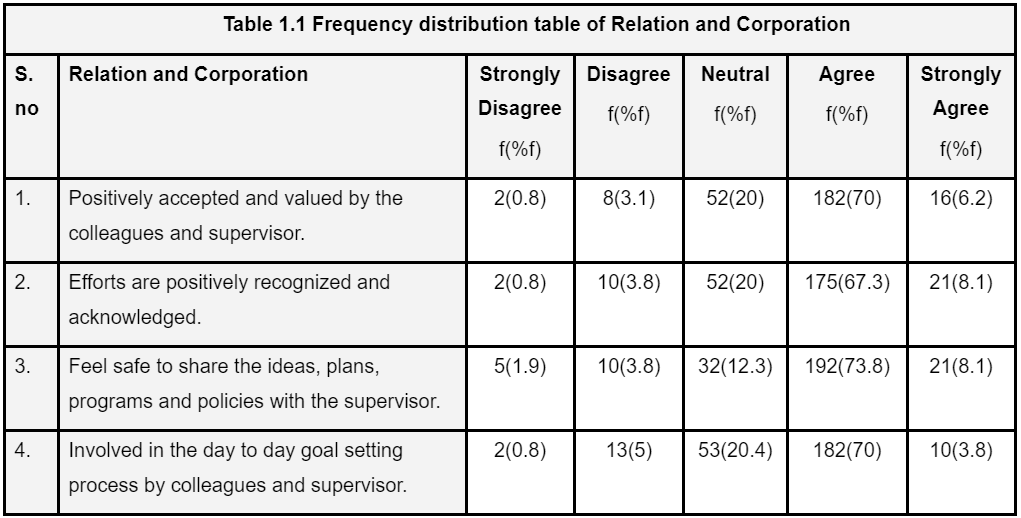
Table 1.1 is showing the responses of software developers. Averagely 76.83% responded positively, 18.17% responded neutrally and 5% responded negatively about the relation and cooperation among employees in the software-houses. It means the IT organizations have realized the importance of the relation and cooperation to resolve day to day job problems. The dynamic high-tech organizations are paying more attention to maintain relations and cooperation among employees. In the modern era of Internet access, it is almost free and easy to stay connected with each other.
Figure 1.1 is the suggested model for the study showing the direct and indirect impact of relations and cooperation at employee job retention.

Figure 1.1 is showing the direct impact of relation and cooperation on the employees job retention. This is also showing the indirect impact of relation and cooperation on employees job retention through the mediating effect of job involvement, job satisfaction and job commitment respectively. Table 1.2 shows that how relation and cooperation is associated with the job involvement, job satisfaction, job commitment and finally job retention.
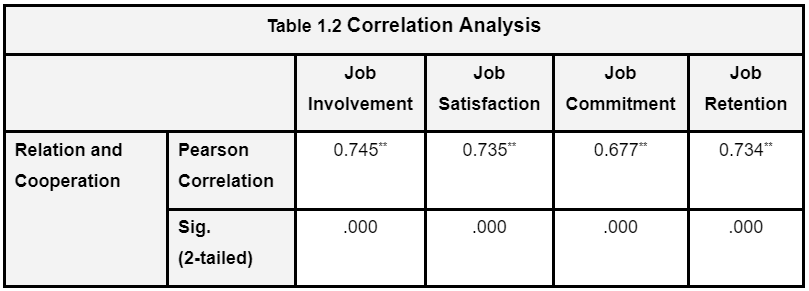
Results show that relation and cooperation is highly positively correlated with job involvement, job satisfaction, job commitment and job retention 0.745, 0.735, 0.677, 0.734 respectively (as the results are closer to +1).
In short, job retention, job involvement, job satisfaction and job commitment can be achieved at a high level by developing the culture of positive relation and cooperation. Effective communication is the backbone of teamwork and effective performance.
Conclusion
Communication is the backbone of the organizational culture. Strong internal relation and cooperation is imperative to fight against the external factors. Developing and promoting the culture of internal relations and cooperation is not only beneficial for organizations but also at employees end. Trust, teamwork, stretching positive behaviours and attitudes, membership plans, productive social interaction are the important constructs of promotion of relation and cooperation among employees. In the modern era of technological advancements, communication has become easy but employees priorities have changed and people are more anti-social. These constructs of relation and cooperation can help organizations to promote the culture of social interactions. Relation and cooperation is helpful in attaining job involvement, job satisfaction, job commitment and employees job retention in the long run.
References
Amarjit, S., & Neil, M. (2007). Improving employee dedication and pro-social behavior. International Journal of Contemporary Hospitality Management, 19(4), 328 – 334.
Arrow, K. (2000). Observations on social capital. In: Dasgupta, Sirageldin (Eds.), Social Capital, 3-5.
Astley, W., & Fombrun, C. (1983). Collective strategy: social ecology of organizational environment. Acadamy Management Review , 576-587.
Becker, G. (1974). A theory of social interaction. Journal of Political Economy, 82, 1063–1093.
Becker, G., & Murphy, K. (2000). Social Economics. Cambridge Massachusetts: Belknap Press of Harvard University Press.
Belliveau, M., O’Rielly, C., & Wade, J. (1996). Social Capital at the top: effect of social similarity and status on CEO compensation. Academy of Management Journal, 29(6), 1568-1593.
Cohen, S. (2004). Social relations and health. American Psychologist, 676–684.
Costa, D., & Kahn, M. (2003). Understanding the American decline in social capital. Kyklos, 56, 17–46.
Flaherty, K., & Pappas, J. (2000). The role of trust in salesperson-sales manager, relationships. The Journal of Personal Selling & Sales Management, 20(4), 271-8.
Fukuyama, F. (1995). Trust: The social virtues and the creation of prosperity. New York: free press.
Gahagan, J. (1984). Social Interaction and its Management. London: Methuen.
George, W. W., & Steven, D. P. (2002). Social Capital and Organizational Commitment. Journal of Business and Psychology, 16(4), 537-552.
Louis, K. S. (1998). Effects of quality of work life in secondary schools on commitment and sense of efficacy. School Effectiveness and School Improvement, 9(1), 1-27.
Murphy, L. (2001). Exploring social interactions of backpackers. Annals of Tourism Research, 28(1), 50-67.
Powell, W., Koput, K., & Smith-Doerr, L. (1996). Interorganizational collaboration and the locus of innovation: networks of learning in biotechnology. Adm Sci Q , 116-145.
Putnam, R. (1995). Bowling Alone: America’s Declining social capital. Journal of Democracy, 10, 24-35.
Saffer, H. (2008). The demand for social interaction. Journal of Socio-Economics, 37, 1047–1060.
Sobel, J. (2002). Can we trust social capital? Journal of Economic Literature, 40, 139–154.
Spagnolo, G. (1999). Social relations and cooperation in organizations. Journal of Economic Behavior & Organization, 38, 1-25.
Springer, A., Parcel, G., Baumler, E., & Ross, M. (2006). Supportive social relationships and adolescent health risk behavior among secondary school students in El Salvador. Social Science & Medicine, 62, 1628–1640.